A Moon Mission Packing List Starts with the Mission Goal
A Moon mission packing list built around its landing plan clarifies which tools belong at the site, how crews will use them, and what can stay behind.
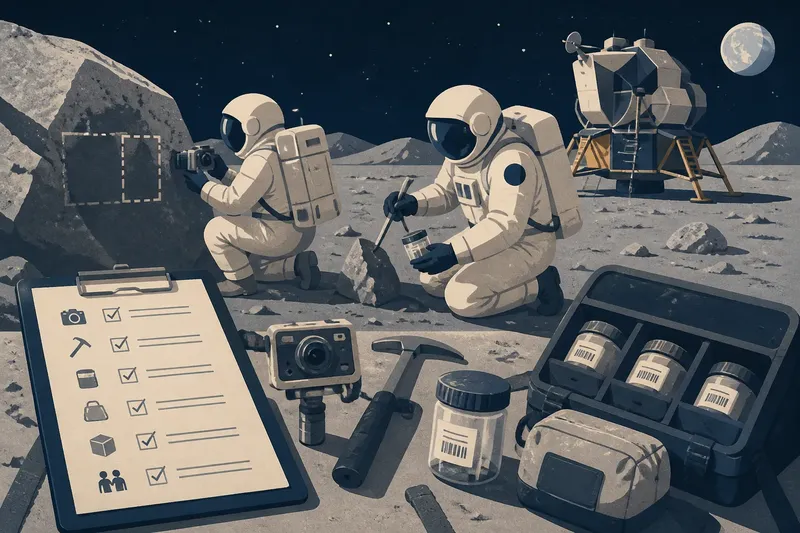
A Moon mission packing list changes sharply when the crew plans to step onto the surface. For a lunar landing, the important choices are not familiar personal belongings but the tools, sample containers, and suit-compatible items that make the assigned surface work possible.
A useful list follows the crew’s route across the site: what they need to see, touch, collect, document, carry, and return with. The route also exposes awkward details—a tool that cannot be reached in a suit or a sample bag with no assigned stowage is not ready for the task.
What will the crew do on the lunar surface?
Describe each activity as an action with an observable result. “Study the site” is vague; “photograph a marked rock face and collect a selected fragment” gives planners something specific to support.
For a surface excursion, the activity sequence might include leaving the lander, moving to a designated work area, documenting features, collecting material, and returning to the cabin. Each action raises a different practical question. Can the crew see the target through the suit helmet? Can they operate the tool with gloved hands? Where does the collected material go next?
Say an invented mission assigns two crew members to photograph a rock face and collect one selected fragment. The sequence would be to identify the target, capture the images, use the approved tool to collect the fragment, place it in its designated container, and secure that container for return. If the crew cannot name where the container is secured, the plan has an unresolved handoff.
Which tools fit a suited crew?
A surface tool must suit both the work and the crew’s restricted movements. Handles, controls, attachment points, and visibility matter as much as the tool’s basic function. A compact camera may record a feature, for instance, but its controls and mounting method must be usable under the mission’s suit conditions.
Consider tools by task rather than by broad category. A crew assigned to document a location may need imaging equipment and a way to identify where each image was taken. A crew collecting samples may need an approved collection tool, containers, and a method of keeping each item associated with its location. The actual choices depend on the mission design and procedures.
When a tool has more than one use, ask whether switching functions interrupts work or creates confusion. A shared tool may be efficient on paper but inconvenient if both crew members need it at the same time.
How should samples be collected and stowed?
Sample handling begins before collection. The crew needs to know which material is wanted, how it will be identified, how it will be contained, and where it will be placed after collection. A clear chain of handling helps prevent a carefully collected item from becoming separated from its location or purpose.
Plan the path from the surface to the return cabin. The container must be compatible with the mission’s handling rules, accessible to the suited crew, and assigned a secure place afterward. Labels or other identification methods should fit the approved procedure rather than being improvised during an excursion.
For an invented plan involving a single selected fragment, the crew could first photograph the target and record its assigned location identifier, then collect the fragment with the designated tool, place it in the matching container, and secure that container in its assigned return stowage. The resulting decision is simple: if the container cannot be matched to the location record, collection should pause until the identification method is resolved.
What belongs on a lunar landing packing list?
Use the following checks to decide what to include. These are planning prompts, not a substitute for mission-approved procedures or equipment specifications.
- Target visibility: Check whether the crew can identify the assigned feature from the planned working position. If it is visible, use the approved observation method; if not, revise the position or observation plan before assigning collection.
- Gloved operation: Check whether the tool’s grip and controls can be used with the mission suit. If they can, assign the tool to the task; if they cannot, select a compatible design or change the task method.
- Tool access: Check whether the tool is reachable at the point of use. If it is, keep its assigned location in the work plan; if not, revise its stowage or the crew’s sequence.
- Sample identification: Check whether each container can be linked to its recorded site. If the link is clear, proceed under the approved procedure; if not, resolve the labeling or recording method before collection.
- Return stowage: Check whether collected material has an assigned secure location for the return trip. If it does, include that location in the handling sequence; if not, do not treat the collection plan as complete.
- Shared equipment: Check whether crew members need the same item simultaneously. If their tasks can be sequenced, assign a handoff point; if they cannot, provide a mission-approved alternative or revise the task timing.
How does a Moon mission packing list change with the landing plan?
A brief landing with one work area differs from a plan involving repeated trips or several sites. A single work area may favor equipment assigned to one sequence. Multiple work areas make carrying, retrieval, and returning tools between locations more prominent. The mission’s actual route determines which distinction matters.
A crew that remains inside its vehicle has no use for surface collection tools. A crew assigned to repeated outdoor work needs a clear method for tracking tools and returning them to their designated places between excursions. A mission with several collection locations also needs an identification method that keeps each sample associated with the correct site.
These differences are not a simple measure of ambition. They are consequences of the planned work, the crew’s movement, and the systems approved for the mission.
What do readers ask about a lunar landing packing list?
Does every surface tool need to be carried by hand?
No. Some equipment may be attached to a suit, secured to a vehicle, or integrated into another approved system. The plan should specify where the tool is and how the suited crew can access it.
How are lunar samples kept identifiable?
The mission needs an approved way to associate each container with its collection location and handling record. The precise method belongs to the mission’s procedures, not an improvised label added during surface work.
Can one tool serve several surface tasks?
It may, if the tool is suitable for each task and changing its use does not disrupt the work. If two crew members need it at once, planners must assign a sequence or an approved alternative.
Who approves equipment for a real lunar mission?
Mission teams evaluate equipment against spacecraft and suit design, crew procedures, and operational requirements. For a real mission, qualified program specialists determine compatibility and approved use.
How can the worked plan reveal a missing item?
Imagine an invented landing plan with a marked rock face, a camera, a collection tool, one sample container, and a designated return stowage location. The crew first reaches the work area and confirms the marked feature; next, one member photographs it while the other prepares the approved collection tool; they then collect the selected fragment, place it in the identified container, and secure it in the assigned location.
Walking through that sequence exposes two decisions. If the camera cannot be operated in the suit, planners need a compatible imaging method or a revised task. If the container has no assigned location in the return stowage, the collection sequence is incomplete even though the tool and container are present.
A Moon mission packing list is clearest when each item has a defined place in a surface task, a handling sequence, and a return plan. For lunar landing equipment, the most useful final check is to follow each object from its stowage point to its work site and back; any unexplained move is a planning question still waiting for an answer.