From Race to Routine: How Spaceflight Became a Continuing Activity
How spaceflight became a continuing activity, from early demonstrations to recurring missions, and what makes sustained work in orbit useful and coherent.
Spaceflight became a continuing activity as missions moved beyond proving that a destination could be reached and began supporting work that had to be repeated. The change was gradual, not a single turning point: early achievements still mattered, while later programs added orbiting laboratories, recurring observations, and systems designed for reuse or maintenance.
That history is not simply a story of competition giving way to routine. The early space race accelerated ambitious projects, and rivalry remains part of space policy. A useful distinction is that a first mission is judged largely by whether it achieves a new capability, while a continuing program must also show how its work connects to what comes next.
How did early milestones become continuing programs?
Early missions often answered sharply defined questions: could a spacecraft reach orbit, could a probe travel to another world, or could people work beyond Earth? The Apollo lunar landings, for example, demonstrated crewed operations on the Moon, while later missions and programs pursued different aims, including sustained human activity in low Earth orbit.
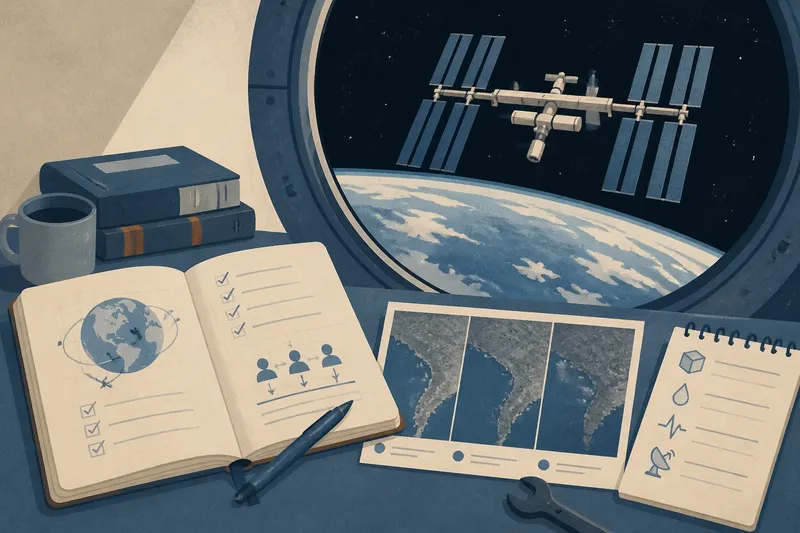
A successful demonstration does not automatically create a routine. A program needs a reason to return, equipment and procedures that can support further work, and a way to carry knowledge forward. The International Space Station illustrates this distinction: it is not a single flight but an orbiting platform maintained through repeated launches, crew rotations, and ongoing operations by international partners.
So when you consider a mission’s legacy, ask what capability or record it leaves available for later work.
Why do recurring missions need a clear purpose?
Repeated activity can become familiar without remaining useful. A spacecraft may continue collecting observations, for instance, but the value of those observations depends on whether they answer a continuing question or provide data that can be compared over time. Repetition alone is not a purpose.
Imagine, as an invented example, that a fictional Earth-observation team has a satellite recording seasonal changes in a coastal region. The team notices that later images use a different instrument setting, making them harder to compare with earlier records. It reviews the data goal, keeps the essential observation method consistent, and documents any other changes. The expected result is a more interpretable record, while the team still has room to add new observations when a fresh question warrants them.
Keep the measurement comparable when continuity matters; change it deliberately when the question changes.
What does it take to sustain human activity in orbit?
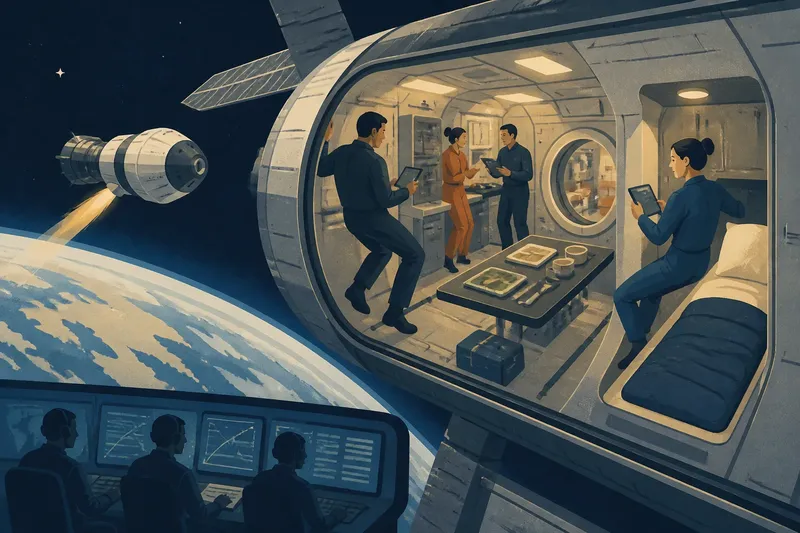
A continuing human presence depends on linked tasks, not just the work an astronaut performs during a research session. Crews need supplies, functioning equipment, communications with mission control, health support, and time to maintain the spacecraft or station. Each task competes for attention and resources, so a mission’s actual capacity is shaped by its operating demands.
Planning also has to account for handovers. A procedure known only to one crew member or control-room team can become a weak point when roles change. Clear records, shared operating instructions, and time for incoming personnel to learn the work help preserve knowledge between rotations.
A mission plan is more credible when it names the work that keeps people able to do the science.
How can programs improve without losing continuity?
Continuity does not require every instrument or procedure to stay unchanged. It requires teams to know which parts of the work need to remain comparable and which can be revised. A long-running observation program might preserve its core method while updating how data are processed; a crewed research program might retain a familiar safety procedure while changing the experiments conducted aboard a station.
Recording those changes helps future teams interpret results. If an observation shifts, a clear account of instrument settings and methods can help distinguish a real change in the environment from a change in how it was measured. That record is useful even when the mission itself is not celebrated as a new first.
What questions do readers ask about continuing spaceflight?
Does routine mean spaceflight has become less ambitious?
No. Routine means a capability or activity can be repeated, not that its purpose is modest. Maintaining a space station or building a comparable record over time can demand sustained technical and organizational effort.
Why do space agencies still compete?
Competition can influence funding, technical choices, and political attention. At the same time, international programs may coordinate operations or share access to facilities, so competition and cooperation can coexist.
What makes a mission part of a continuing program?
It contributes to work that extends beyond its own completion, such as an ongoing observation record, an operational capability, or knowledge that informs later missions. The connection should be visible in what the next team can use.
How can the public judge a mission without a dramatic first?
Ask what the mission enables, what information it adds, and how later work can use its results. Those questions help reveal value that a headline about a first may not capture.
What should a mission leave ready for the next one?
Spaceflight’s continuing character is clearest in the links between missions: observations that can be compared, procedures that another crew can follow, or equipment and experience that support further work. These links do not remove the importance of milestones. They show how a milestone can become part of a larger effort rather than an endpoint.
To understand how spaceflight became a continuing activity, look for the specific handover: what data, operating knowledge, or capability remains usable after the mission ends. That is often a more revealing sign of progress than novelty alone.